You want to get married in Ireland. You live in America. You are not sure what paperwork is involved, how far in advance you need to start, or whether any of this is even legal. This guide answers all of it, clearly, in order, with no filler.
This is not a destination inspiration post. It is the legal process for getting married in Ireland, step by step, written for American couples in 2026. We cover the notice requirements, the documents you need, the realistic timeline, ceremony type options, and what to do with your Irish marriage certificate when you get home.
The short answer: Yes, Americans can legally get married in Ireland. You need to give at least three months notice to the Irish civil registrar before the ceremony. You will need your passport, birth certificate, and proof that you are free to marry. The process is manageable, and every couple Ladybird has worked with has navigated it without a hitch. Here is exactly how it works.
If you want the legal steps handled from the US, Ireland elopement packages start from $5,900, contracted in USD.
See Ireland elopement packagesIf you are still in the research stage, our guide to how to elope in Ireland covers the experience side, what it actually feels like to plan a wedding 4,000 miles from home, what questions to ask, and whether Ireland is the right fit for you. If you have already decided, keep reading for the legal roadmap.
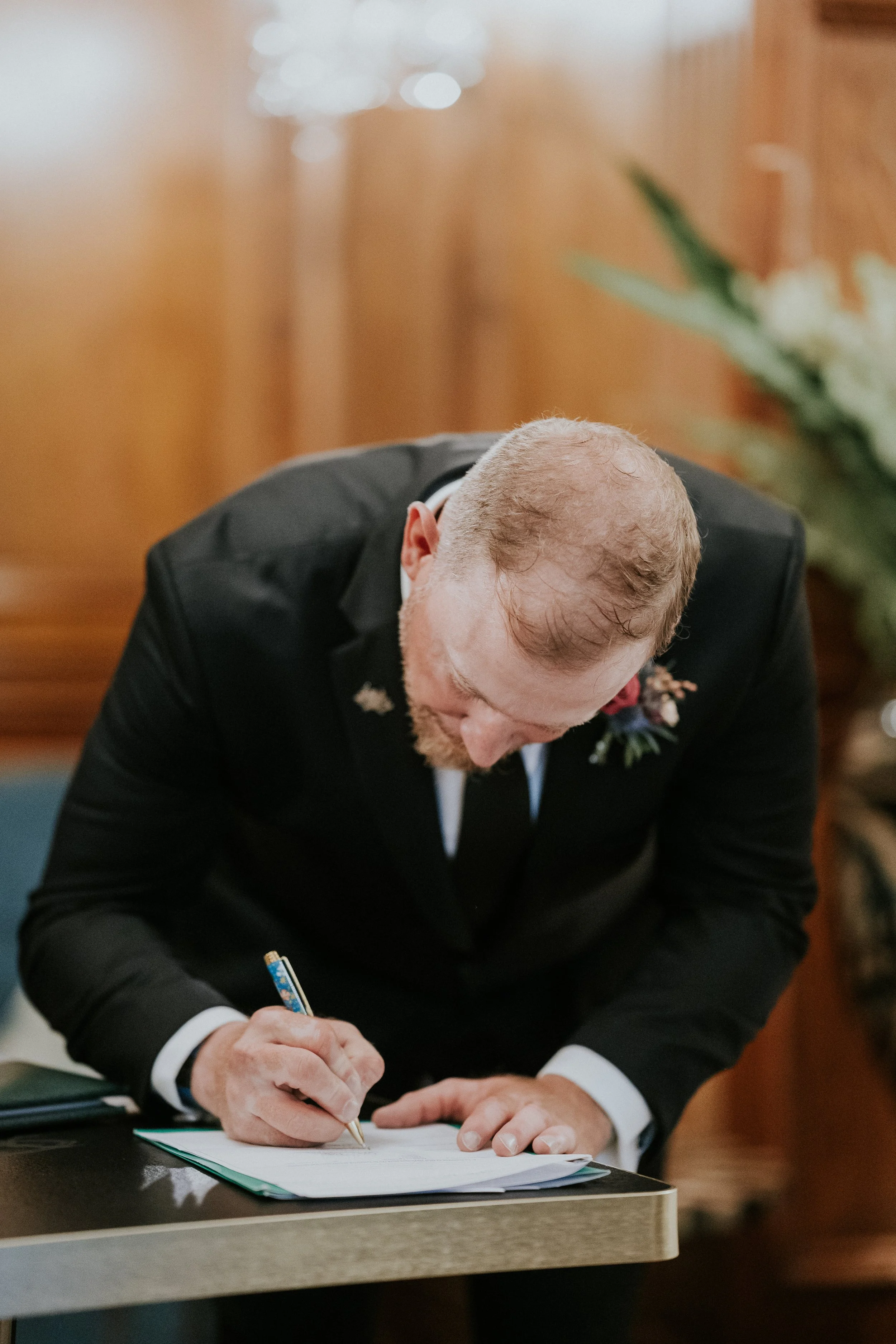
The legal moment. Signing the Marriage Registration Form is what makes it official under Irish law. Photographer: Awake and Dreaming
The basics
Can Americans Legally Get Married in Ireland?
Yes. Full stop. American citizens can marry legally in Ireland, and that marriage is recognized in the United States. You do not need Irish citizenship, Irish ancestry, or a long-stay visa. You follow the notice process, you get married, and you leave with a legal Irish marriage certificate.
Ireland recognizes civil, religious, and humanist ceremonies, all legally binding. The country has a long tradition of outdoor and castle ceremonies, which is why so many US couples choose it over other European destinations. The scenery is one reason. The legal simplicity is another. If you want the full overview of what eloping in Ireland actually looks like, read our complete guide to eloping in Ireland.
What Ireland offers that nowhere else does
- No residency requirement. You do not need to live in Ireland or visit before the wedding day.
- English-language paperwork throughout. No translations needed for most US documents.
- Three months notice is the key legal requirement, and it can be arranged remotely in most cases.
- Your Irish marriage certificate is valid in all 50 US states once you return home.
- No waiting period, no blood tests, no pre-marital counselling requirements under Irish civil law.
One important point: the three-month notice rule is non-negotiable. It applies to all couples marrying in Ireland, regardless of nationality. Build your timeline around it.
Residency rules
Do You Need to Live in Ireland to Get Married There?
No. Ireland has no residency requirement for marriage. You do not need to live in Ireland, hold Irish citizenship, have Irish ancestry, or spend any minimum number of days in the country before your wedding. Foreign nationals of any nationality can marry legally in Ireland, and the rules are the same for everyone.
This is one of the reasons Ireland works so well for American couples. Some European countries require one partner to establish residency for weeks or months before the ceremony. Ireland does not. You arrive, you marry, you go home with a legal marriage certificate.
What foreign couples do need
- Three months formal notice to a civil registrar before the ceremony date. This applies to every couple marrying in Ireland regardless of nationality.
- Both partners present in person at the Civil Registration Service appointment.
- Valid passports, long-form birth certificates, and evidence that you are free to marry.
- Documents in English, or officially translated. Most US documents need no translation.
There is no minimum stay before or after the wedding, no waiting period once you arrive, and no requirement to visit Ireland in advance beyond the notice appointment itself.
The short version: Ireland places no residency, nationality, or minimum-stay condition on marriage. The only universal requirement is the three-month notice period, and it applies to Irish and foreign couples alike.
US citizens travelling to Ireland for a wedding do not need a visa for stays under 90 days. That covers both the notice appointment visit and the wedding itself.
The legal process
How to Get Married in Ireland: The 5 Steps
Ireland's marriage process is more straightforward than most couples expect. There are five steps. Follow them in order and you will be legally married in Ireland without a single surprise.
Choose your solemniser
Before you can give notice, you need to know who will conduct your ceremony, because their details go on the notice form. In Ireland, ceremonies must be conducted by a registered solemnizer: a civil registrar, an authorized religious minister, or a licensed humanist or secular celebrant.
Most couples working with Ladybird Ever After use a professional secular celebrant. Someone who can write a fully personalized ceremony with no religious elements and no constraints on where or when you marry. Celebrants are the most flexible option for outdoor ceremonies, castle elopements, and weddings at locations like the Cliffs of Moher or Dunluce Castle.
If you prefer a civil ceremony, you will need to book through the local civil registrar's office in the county where you plan to marry. Civil ceremonies require a registered venue. Browse our full venue guide to see every location Ladybird works with across the island.
Legal requirements
What Is the Minimum Age to Get Married in Ireland?
In the Republic of Ireland, both partners must be at least 18 years old at the time of the ceremony. There are no exceptions. Under the Civil Registration Act 2004, the minimum age of marriage is 18 for both parties. Prior to 2019, it was possible for a person under 18 to marry with court approval. The Family Law (Age of Marriage) Act 2019 removed that exemption entirely. If either partner is under 18 on the wedding day, the marriage cannot legally proceed in the Republic of Ireland under any circumstances.
Northern Ireland follows UK law. The minimum age is 16 with parental or guardian consent if either partner is under 18. At 18 or older, no parental consent is required. This is a relevant distinction if you are considering venues on the Northern Ireland side of the border, such as Dunluce Castle in County Antrim.
Important: If either partner is under 18, you cannot legally marry in the Republic of Ireland under any circumstances. There are no exceptions. No court order, no parental consent mechanism, no workaround. The 2019 legislation removed all such provisions.
Can you get married at 16 in Ireland?
No. In the Republic of Ireland the answer has been no since 2019. Before then, a person under 18 could marry with a court exemption order. The Family Law (Age of Marriage) Act 2019 abolished that route completely. There is no parental consent mechanism, no court application, and no exception for any circumstance.
Northern Ireland minimum marriage age in 2026
Northern Ireland is a separate jurisdiction with separate law. Currently, 16 and 17 year olds can marry there with parental or guardian consent, and 18 and older can marry freely. A bill to raise the minimum age to 18 with no consent exception has been introduced at the Northern Ireland Assembly but has not completed the legislative process. The existing 16-with-consent rule remains in force until any new law passes and takes effect. Check the current position before relying on this if your venue is in Northern Ireland.
One further point worth knowing: a marriage in Northern Ireland involving anyone under 18 is not recognised in the Republic of Ireland, because the Republic sets 18 as an absolute minimum regardless of where the ceremony took place.
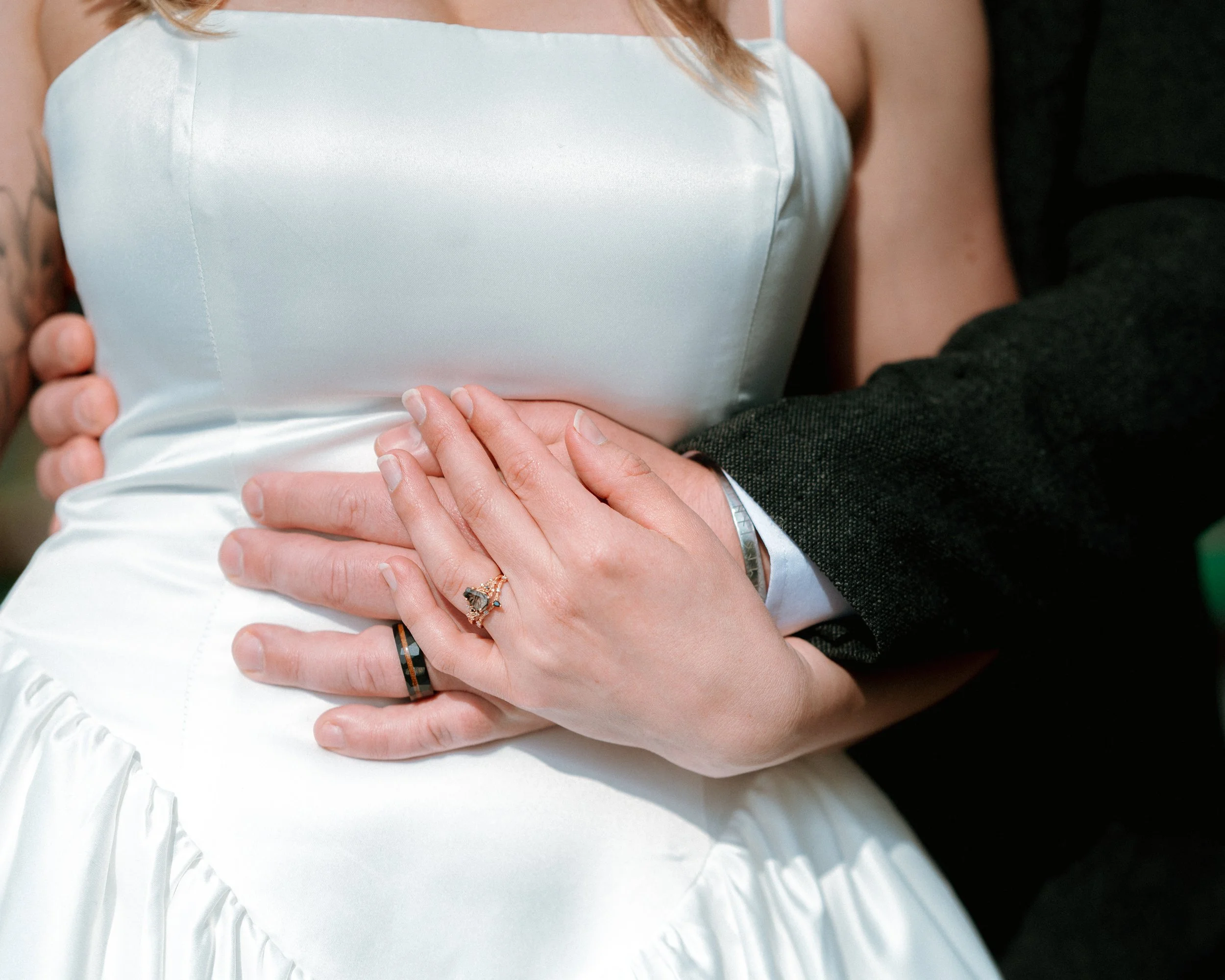
Officially married. The rings go on. The form is signed. That is it. Photographer: Dylan Clifford
Give formal notice to the Civil Registrar (HSE)
This is the step that catches most couples off guard. At least three months before your wedding date, both partners must give formal notification of your intention to marry to a civil registrar in Ireland. This happens at a local HSE Civil Registration Service office.
Both of you need to attend in person. This is the one step that requires a physical visit to Ireland before the wedding day if you have not already planned a scouting trip. Many couples combine this with a venue visit or a pre-wedding trip. You can give notice up to six months in advance.
The fee is 200 euros for both partners combined. You will bring your identification and required documents to the appointment. The registrar reviews everything, records your details, and issues a Marriage Registration Form (MRF), which your solemniser uses on the day.
Can you give notice by post or online?
No, not as a replacement for the appointment itself. Both partners must attend the Civil Registration Office in person to give formal notice, and that requirement is fixed. What the HSE does allow is a limited preliminary notification by post for couples resident outside Ireland, submitted in advance of the trip. This lets you reserve your slot earlier, but it does not replace the in-person appointment. Contact the Civil Registration Office in your chosen county to ask whether the postal preliminary notice applies to your situation.
Gather and submit your documents
At your Civil Registration appointment, you will need to bring original documents for both partners. Certified copies or photocopies are not accepted. See the full checklist in the section below, but the core items are your passport, birth certificate, and a declaration of freedom to marry.
If either partner has been married before, you will need to provide your divorce decree or the death certificate of a former spouse. Divorce documents issued in the US are generally accepted, but check with the civil registrar in your county in advance.
Conduct the ceremony
Your solemniser officiates using the Marriage Registration Form issued at step two. The ceremony must include a legal declaration: a short phrase each partner says confirming they are free to marry and are taking each other as a legal spouse. Your celebrant will guide you through this. It takes about thirty seconds and can be woven seamlessly into the rest of the ceremony. See the Civil Registration Act 2004, Section 46 for the statutory requirements.
Two witnesses must be present. They sign the Marriage Registration Form alongside you and the solemniser immediately after the ceremony. Witnesses can be guests, friends, or in some cases the venue coordinator. They must be 18 or older in the Republic of Ireland.
Outside of the legal declaration and witnesses, the ceremony is entirely yours. Your celebrant writes and performs whatever you ask for: vows, readings, rituals, music, or silence. There are no required religious elements for civil or humanist ceremonies.

Hayley and Corbin at the Cliffs of Moher. A secular celebrant made this ceremony legally possible outside a registered venue. Photographer: Awake and Dreaming
Register the marriage and receive your certificate
After the ceremony, your solemniser submits the signed Marriage Registration Form to the civil registrar's office. The marriage is then formally registered in the Irish State Register of Marriages, usually within a few days of the ceremony.
Your official Irish marriage certificate is issued by the General Register Office. You can request it online through the Irish GRO website. Standard processing takes a few weeks, and an expedited option is available if you need it sooner. For religious ceremonies, solemnisers can be found through the Diocese of Elphin, Church of Ireland, and other recognized bodies. For secular ceremonies, registered celebrants include those from Entheos Ireland and One World Ministries.
Once you have your Irish marriage certificate, take it home and use it exactly as you would a US certificate: for name changes, joint accounts, insurance updates, and anything else that requires proof of marriage.
We handle the HSE notification, document checklist, and celebrant booking for every couple we work with.
See our packagesWhat you will need
Documents Required to Get Married in Ireland
Bring these to your Civil Registration appointment. Both partners need to present their own documents. Bring originals: certified copies are not accepted at the appointment. For details on all requirements, refer to the HSE Civil Registration Service official guide.
Required documents for each partner
- Valid passport used as the standard photo ID for the appointment
- Full birth certificate (long-form, showing both parents' names; short-form not accepted)
- Proof of address such as a utility bill, bank statement, or official letter dated within the last three months
- Evidence of marital status, typically a statutory declaration confirming you are free to marry
- If previously married: divorce decree absolute issued by the court, not just a separation agreement
- If previously married: former spouse's death certificate if widowed
- PPS number if you have one (most visiting Americans will not; the civil registrar has an alternative process in place)
A note on birth certificates for Americans
Most US birth certificates come in a short form (single page, key facts only) and a long form (full record showing parents' names). Ireland requires the long form. Order it from your state vital records office well in advance. Some states take three to four weeks to process requests.
Do American documents need to be apostilled?
In most cases, no. The Irish civil registration system accepts US-issued documents directly without apostille or notarisation for standard marriages. However, if your divorce was granted in a country other than Ireland, England, or Wales, the civil registrar may need a court order or apostille confirming the divorce is valid under Irish law. Check with the registrar in your county when you book your appointment.
Terminology
Is There a Marriage License in Ireland?
No, and this trips up almost every American couple. Ireland does not issue a marriage license. There is no county clerk, no license window, no document you collect and carry to the ceremony the way you would in the US.
What Ireland issues instead is the Marriage Registration Form, usually shortened to MRF. It is the Irish equivalent of a marriage license, and it is the document that makes your ceremony legal.
US Marriage License vs Irish Marriage Registration Form
What Americans expect compared with what Ireland actually issues
| Stage | United States | Ireland |
|---|---|---|
| What you apply for | Marriage license | Formal notification of intention to marry |
| Where you apply | County clerk or equivalent | HSE Civil Registration Service office |
| How far in advance | Typically days to weeks | At least 3 months, no more than 6 months |
| Document you receive | Marriage license | Marriage Registration Form (MRF) |
| What happens on the day | License signed and returned | MRF signed by both partners, two witnesses, and the solemniser |
| Proof of marriage afterwards | Certified marriage certificate | Irish marriage certificate from the General Register Office |
How to register your marriage in Ireland
Registration is not a separate errand you run after the wedding. Your solemniser returns the signed Marriage Registration Form to a civil registrar, and the marriage is entered in the Register of Marriages. Once that is done you can order your marriage certificate.
Getting your Irish marriage certificate
The certificate is issued by the General Register Office. It is the document you will actually use back home for name changes, insurance, taxes, and anything else that asks for proof of marriage. Order extra certified copies while you are arranging the first one. It is far easier than requesting them from overseas later.
Plain answer: If you are searching for a marriage license in Ireland, the Marriage Registration Form is what you are looking for. You get it by giving three months notice to a civil registrar, not by applying for a license.
The legal fees
What the Legal Process Costs
The legal side of getting married in Ireland is inexpensive. These are the only mandatory costs.
- Civil registration fee: 200 euros, covering both partners, paid at the notice appointment.
- Solemniser fee: a licensed secular or humanist celebrant typically charges between 700 and 1,200 euros.
- Marriage certificate: approximately 20 euros per certified copy from the General Register Office.
Total legal costs land well under 1,500 euros for most couples. Everything else, the venue, the photographer, the flowers, the travel, sits outside the legal process entirely.
For the full picture of what an Irish wedding actually costs, read our 2026 destination wedding budget guide. Couples working with Ladybird are contracted in USD through a US company, so none of these figures are exposed to exchange rate movement between booking and wedding day.
One USD invoice. One American company. You never send money to Ireland.
Get in touchTiming
How Long Does It Take to Get Married in Ireland?
The legal minimum is three months. That is the notice period required by Irish law, and it cannot be shortened, waived, or fast-tracked. From the day you give formal notice to a civil registrar, you must wait at least three months before you can legally marry.
The realistic answer for most American couples is longer, because the notice appointment is not the first step. You need documents in hand before you can give notice, and US vital records offices are slow.
The fastest legal path
- Weeks 1 to 4: Order long-form birth certificates from your state vital records office. This is the step most likely to delay you.
- Weeks 4 to 6: Book your Civil Registration Service appointment and your solemniser.
- Week 6: Attend the notice appointment in Ireland with both partners present.
- Three months later: The earliest date you can legally marry.
That puts the genuine minimum at roughly four and a half to five months from a standing start. Anyone promising faster than that in the Republic of Ireland is either mistaken or talking about a symbolic ceremony rather than a legal one.
Short on time? Northern Ireland requires 28 days notice rather than three months. It is a different legal jurisdiction with its own process, and the resulting marriage is equally valid in the US. See the comparison below.
For a comfortable timeline with room for document delays and venue availability, plan on 9 to 12 months. Peak season dates from May to September book furthest ahead.
Planning timeline
The Realistic Timeline for Getting Married in Ireland
Most couples book 9 to 12 months out. Here is how the timeline looks when you work backwards from your ceremony date.
Choose your venue and secure your date
Popular castle venues and exclusive-use properties fill up fast, especially for May, June, and September. Secure the date and pay the deposit before anything else.
Book your celebrant or civil registrar
Your solemniser details are needed for the HSE notice form. Book them before you give notice. Good celebrants are often booked out a full year ahead in peak season.
Order your documents
Request your long-form birth certificate from your state vital records office. If you have been previously married, locate your divorce decree. Allow 4 to 6 weeks for delivery.
Give formal notice at the HSE Civil Registration Service
Book your in-person appointment in Ireland. Both partners must attend. Bring all documents. The 200 euro fee is paid at this appointment. You leave with your Marriage Registration Form.
Finalise ceremony details with your celebrant
Write your vows, confirm the ceremony structure, plan readings and music. Your celebrant guides the process. Most couples do two or three calls over this period.
Ceremony and signing
Your solemniser officiates. Both partners make the legal declaration. Two witnesses sign the Marriage Registration Form. You are legally married in Ireland.
Receive your Irish marriage certificate
Your solemniser submits the form. The marriage is registered. You request your official certificate from the Irish GRO and receive it by post or digitally.
Can you do it faster? Yes, within limits. The three-month notice requirement is fixed. But couples have successfully planned the rest in six months for off-peak dates. For spring and autumn, twelve months is safer. Do not cut the HSE notice appointment close. If documents are delayed, there is no legal fallback.
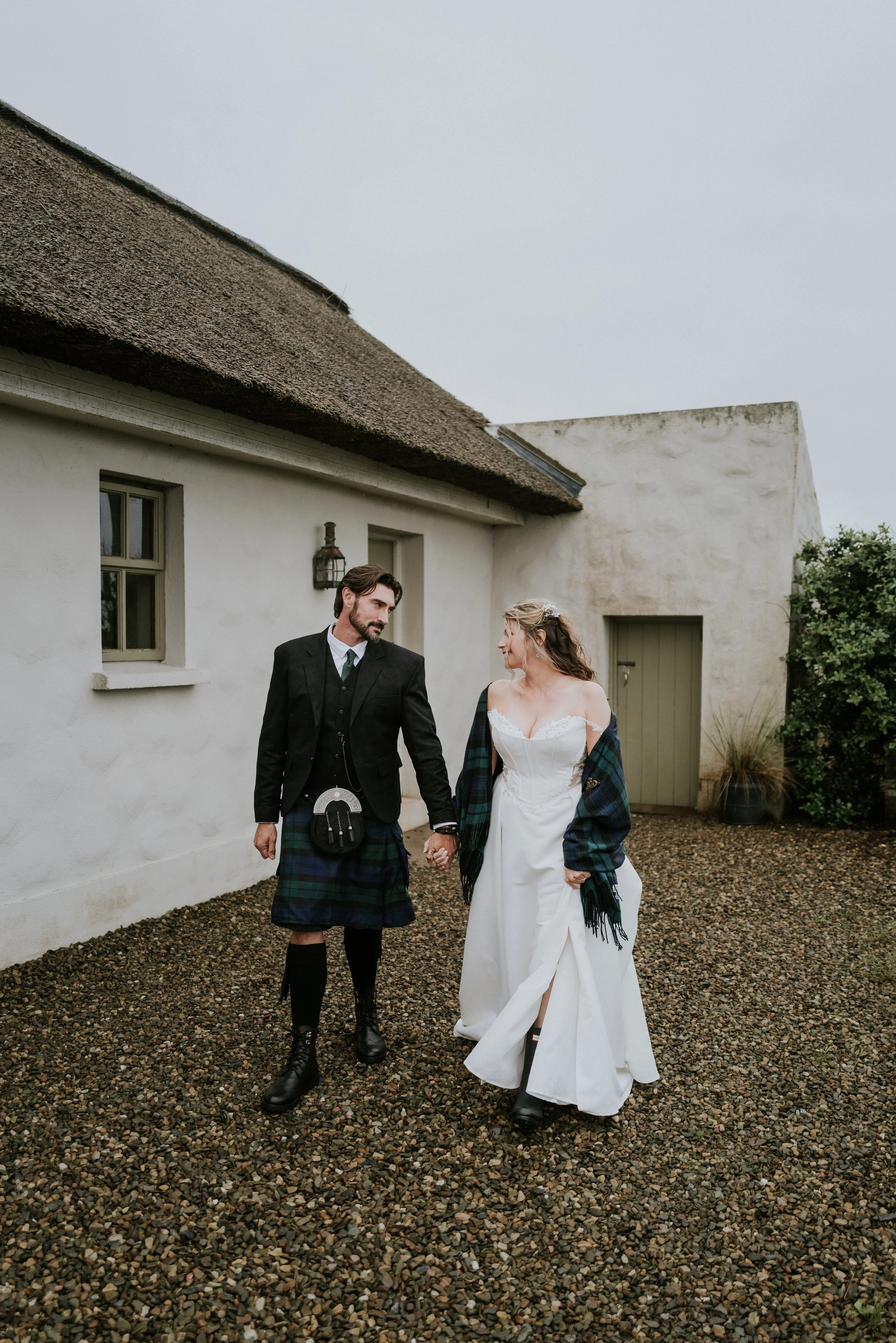
Sebrina and John after their ceremony. The paperwork is done. This part is all yours. Photographer: Awake and Dreaming
Know the difference
Republic of Ireland vs Northern Ireland: What Changes?
Ireland is one island but two separate legal jurisdictions. The Republic of Ireland and Northern Ireland have different notice requirements, different fees, and different legal processes. If you are considering venues on both sides of the border, such as Dunluce Castle in Antrim (Northern Ireland) versus Ross Castle in Kerry (Republic of Ireland), the rules that apply depend on which country your venue is in. For Northern Ireland specifics, consult nidirect - Getting Married.
Republic of Ireland vs Northern Ireland: Marriage Requirements 2026
Key legal differences for American couples planning an Irish wedding
| Requirement | Republic of Ireland | Northern Ireland |
|---|---|---|
| Minimum Notice | 3 months Strict | 28 days 10 to 12 weeks recommended |
| Best Lead Time to Plan | 9 to 12 months | 10 to 12 weeks minimum |
| Notification Fee | 200 euros (both partners combined) | 44 GBP (22 GBP per person) |
| Legal Document Issued | Marriage Registration Form (MRF) | Marriage Schedule |
| Document Validity Period | 6 months | 12 months |
| Humanist Weddings | Legal since 2012 | Legal since 2018 |
| Minimum Age | 18 No exceptions | 16 with parental consent |
| Witness Age Requirement | Must be 18 or older | Must be 16 or older |
| Immigration Checks | Standard checks | Intensive (UK Home Office) |
For most American couples, the Republic of Ireland is the simpler choice: more venue options, a longer track record on humanist ceremony law, and no UK immigration layer. Northern Ireland is the right answer if your heart is set on a specific venue in Antrim or along the Causeway Coast. See our guide to Ireland's regions if you are still deciding where in the country to marry.

Dunluce Castle, County Antrim. Northern Ireland, its own legal process, and its own kind of dramatic backdrop. Photographer: Victoria Whiting
Your options
Civil Marriage in Ireland, Religious, or Humanist: Which Ceremony Is Right for You?
Ireland recognizes three types of legally binding marriage ceremony. Here is how they compare for American couples planning from abroad. For a complete list of authorized solemnisers, check the Register of Solemnisers.
Ceremony Types in Ireland Compared
Location flexibility, personalization, and what to expect from each option
| Ceremony Type | Who Conducts It | Location Flexibility | Best For |
|---|---|---|---|
| Civil (Registry Office) | State civil registrar | Registration office or registered venues only | Couples who want the most formally standard legal option |
| Religious | Authorised minister of religion | Church or approved venue | Couples with active religious faith and a specific denomination |
| Humanist or Secular | Licensed humanist celebrant | Almost anywhere: clifftops, castles, beaches, private land | Most Ladybird couples who want maximum location freedom and a fully personalized ceremony |
Getting married in a registry office in Ireland
A registry office wedding, more accurately a civil ceremony at a Civil Registration Service office, is the most stripped-back legal option in Ireland. A state civil registrar conducts the ceremony at the registration office itself. Offices operate in Dublin, Cork, Galway, Limerick, and other towns nationwide.
The trade-off is location. A civil registrar can only marry you at the registration office or at a venue formally registered for civil ceremonies. That rules out clifftops, castle grounds, beaches, and private estates. It also means the ceremony content is largely fixed, with limited room for personal vows or readings.
Most American couples marrying in Ireland choose a solemniser instead, precisely because a civil marriage ties them to an approved building. Some couples do both: a short civil ceremony to satisfy the legal requirement, followed by a personal ceremony wherever they actually want to stand.
The vast majority of American couples marrying in Ireland choose a secular or humanist celebrant. The location freedom is the primary reason. A civil ceremony ties you to a registered venue. A celebrant lets you marry on a clifftop, in a castle courtyard, by a lake, or in a field, and it is all entirely legal.
Back in the US
What Happens After Your Irish Wedding
Once you are home, your Irish marriage certificate works exactly like a US marriage certificate. Here is what to do with it.
Is an Irish Marriage Legal in the US?
Yes. Under the principle of comity, US states recognize legal marriages performed abroad, provided the marriage was valid under the laws of the country where it took place. An Irish marriage that follows the correct notice and ceremony process is valid everywhere in the United States. You do not need to re-register the marriage or file anything with a US court.
Changing your name after an Irish wedding
Use your Irish marriage certificate exactly as you would a domestic certificate. Take it to the Social Security Administration to update your Social Security record. Then use your updated card to update your driver's license and passport. Banks, insurance companies, and other institutions will accept the Irish certificate directly.
What about taxes and joint filing?
An Irish marriage is legally recognized for US federal tax purposes. You can file as Married Filing Jointly in the same tax year your wedding takes place, regardless of when you returned home. Consult your tax advisor for guidance specific to your situation.
Want a full checklist of everything to do before, during, and after your Irish wedding?
Read our FAQsCommon questions
Frequently Asked Questions About Getting Married in Ireland
Yes. Both partners must appear in person at the Civil Registration Office to give formal notice. This is a legal requirement under the Civil Registration Act, and the in-person appointment cannot be replaced by post or online. Couples resident outside Ireland can submit a preliminary notification by post in advance to reserve their slot, but the in-person appearance is still mandatory. Most couples combine this visit with a venue walkthrough or early scouting trip. If you are working with a planner, they can schedule everything into one efficient visit.
You can give notice between three and six months before the ceremony. You cannot give notice more than six months in advance. The three-month minimum is fixed by law. If you give notice less than three months before the ceremony, the marriage cannot legally proceed. Build in a buffer of at least four to five months to allow for document delays.
You will need to bring your divorce decree absolute to the Civil Registration appointment. If your divorce was granted in the US, it is generally accepted as valid under Irish law. If your divorce was granted in a country with very different family law, the civil registrar may need a court declaration confirming the Irish state recognizes it. Contact your county's civil registration office in advance if you are unsure.
US citizens do not need a visa to visit Ireland for up to 90 days under the visa-free travel agreement. This covers your pre-wedding HSE notice visit and the wedding itself, provided your total stay is under 90 days. If you are planning an extended stay beyond 90 days, consult the Irish Naturalisation and Immigration Service in advance.
No. Your passport is valid in your current name for its remaining validity period. You do not need to update it before returning home. You can request a new US passport after you are back, using your Irish marriage certificate to document the name change. Your current passport is perfectly valid for travel.
Yes, with a secular or humanist celebrant. Civil ceremonies must take place at a registered venue. A licensed celebrant can legally marry you almost anywhere in Ireland: the Cliffs of Moher, a castle courtyard, a private beach, a forest clearing. The legal ceremony happens wherever you are standing when you make your vows and sign the Marriage Registration Form. This is one of the most significant advantages of using a celebrant over the civil registrar route.
Total legal costs are well under 1,500 euros for most couples. See what the legal process costs above for the full breakdown.
You do not legally need one. But most American couples working without a planner underestimate the logistics of coordinating the HSE notice appointment, ensuring documents are correct, booking the right celebrant, and managing vendors from 4,000 miles away across time zones. A US-based planner who specializes in Irish weddings handles all of that. Your contract is in dollars, with a contact who works in your time zone.
They are two different legal jurisdictions. The Republic requires a minimum of three months notice and operates under Irish civil law. Northern Ireland requires a minimum of 28 days notice and operates under UK law. Fees, documents, and immigration checks also differ. See the comparison table above for the full breakdown. If your dream venue is in Kerry, Clare, Galway, or Wicklow, you are in the Republic. If it is in Antrim or along the Causeway Coast, you are in Northern Ireland.
In the Republic of Ireland, the minimum age is 18 for both partners. There are no exceptions. The Family Law (Age of Marriage) Act 2019 removed the previous provision that allowed under-18s to marry with court approval. If either partner is under 18, the marriage cannot legally proceed in the Republic of Ireland under any circumstances.
In Northern Ireland, the minimum age is 16 with parental or guardian consent for both parties if either is under 18. At 18 or older, no parental consent is required. Northern Ireland follows UK law, which differs from the Republic on this point.
Yes. Ireland has no residency or nationality requirement for marriage. Foreign nationals of any nationality can marry legally in Ireland. The only universal requirement is giving at least three months formal notice to a civil registrar before the ceremony, and that applies to Irish and foreign couples alike.
No. There is no residency requirement and no minimum stay. You do not need to live in Ireland or visit in advance beyond attending the notice appointment in person with your partner.
Ireland does not issue a marriage license. The equivalent document is the Marriage Registration Form, or MRF, which you receive after giving three months notice to a civil registrar. It is signed on the wedding day by both partners, two witnesses, and the solemniser.
The legal minimum is three months from the date you give formal notice to a civil registrar. Allowing time to order long-form birth certificates and book appointments, the realistic minimum for American couples is about four and a half to five months. Most couples plan 9 to 12 months ahead.
Disclaimer: This information is provided for general guidance purposes only and does not constitute legal advice. Marriage laws and requirements are subject to change. Always verify current requirements directly with the official Registrar in your chosen jurisdiction (HSE Civil Registration Service for the Republic of Ireland or your local District Council for Northern Ireland) before making any wedding plans or legal decisions.
Ready when you are
Let's Make Your Irish Wedding Happen
You have done the reading. We will handle the paperwork, the celebrant, the venue, and every detail in between, so you just show up and get married.